
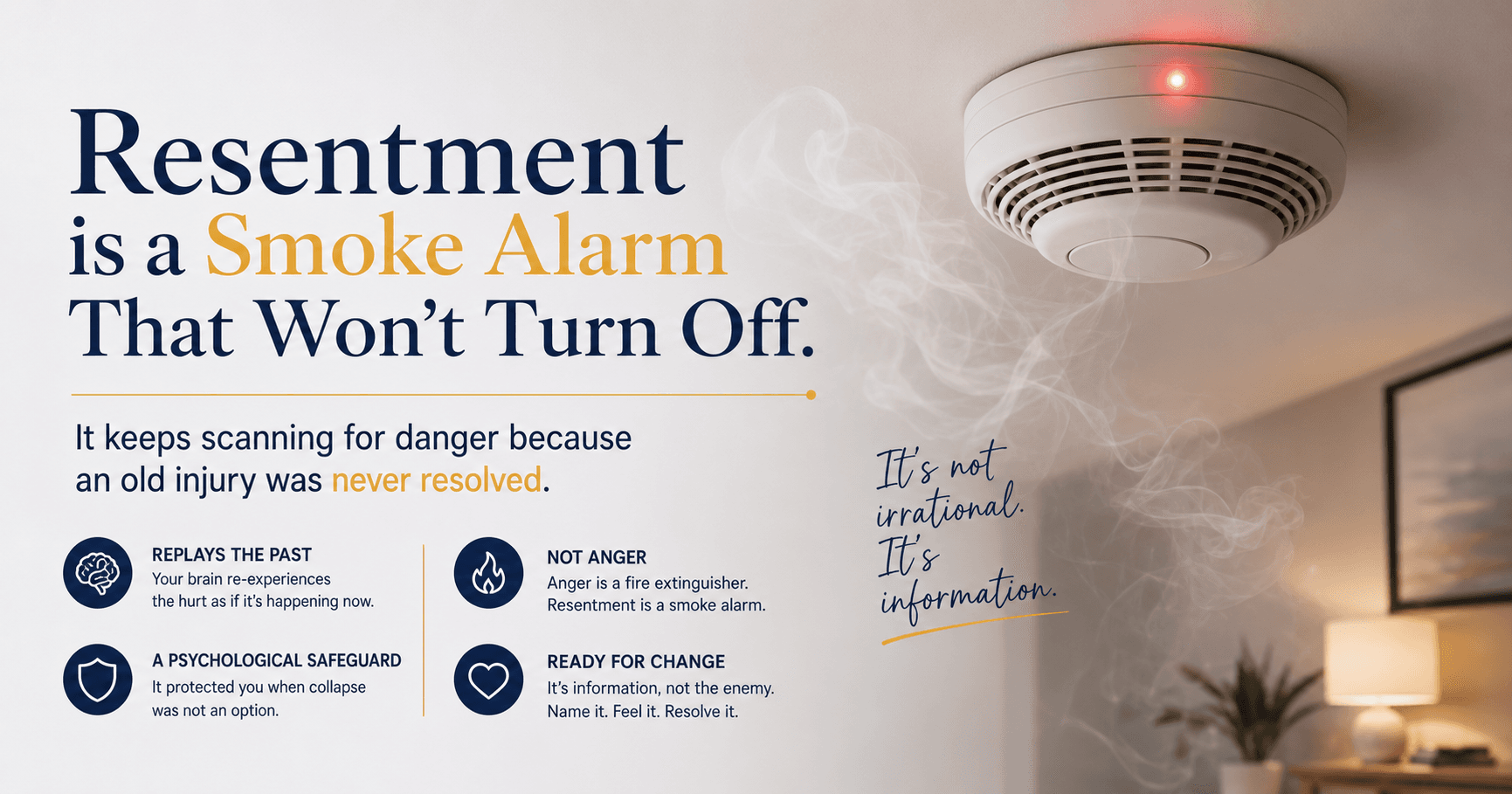

There is a conversation you have been replaying since Tuesday. Maybe longer. Every time you settle into something quiet — in the car, before sleep, in the two minutes between tasks — it comes back. What was said. How it was handled. The fact that it was never acknowledged.
That is not a character flaw. That is resentment. And it has a job.
What the Word Actually Means
The word comes from the Latin roots re (again) and sentir (to feel). Literally: to feel a past injury again and again. Not once. Not twice. Again and again, until something changes.
Psychologists describe it as a tertiary emotion — meaning it grows after primary feelings like hurt or fear were experienced and then suppressed rather than addressed. Something happened. You felt it. You moved on without fully resolving it. The feeling did not move on with you.
It settled. It layered. And it has been there since.
The Smoke Alarm That Won't Turn Off
Anger and resentment are not the same thing.
Anger is immediate. A fire extinguisher — it responds to a present threat, discharges, and exhausts itself. Resentment is a smoke alarm that someone set and then nobody came to turn off. It stays on. It keeps scanning the horizon for signs that the same person, or someone like them, is about to hurt you again.
This is not irrational. The amygdala activates within 100 milliseconds of a perceived threat. When you ruminate on a grievance, the brain does not just remember what happened. It re-experiences it. Heart rate rises. Muscles tighten. The sympathetic nervous system responds as if the danger is still present.
Your body is replaying the file.
Where It Builds
In relationships, resentment usually begins with an imbalance in emotional labor. Someone is doing more of the invisible work. Tracking the details that hold everything together. Sensing when the relationship needs repair and quietly handling it. At some point the gap between what is being given and what comes back becomes too wide to rationalize. You stop mentioning it. The resentment starts accumulating.
At work it often begins with what could be called performance punishment. You are dependable, so you get more. You stay late while someone less reliable heads home. You produce, and the reward is more to produce. Nobody labels it that way. It does not feel like a compliment either.
Neither of these is "all in your head." They are real imbalances. Your resentment is the record of them.
Why You Hold Onto It
This is worth sitting with: resentment is not just a side effect of being hurt. It is a psychological safeguard.
When something genuinely harmful happened and the nervous system had to choose between collapse and continuing, resentment is often what kept you going. It provides a sense of being right. It offers protection against further vulnerability. It holds a kind of fighting spirit alive when everything else feels depleted.
Letting it go is not simple, because letting go means facing what is underneath it. The grief. The real hurt — that you were treated that way, that it was never acknowledged. And often, the older pain it landed on when it arrived, because it rarely lands clean.
Your resentment is childlike in this way. Not childish. Childlike. It is the part of you still waiting to be seen. Still waiting for someone to say: that was wrong, and you deserved better.
That is a very human thing to need.
When It Starts Costing More Than It Protects
The problem is that over time, resentment becomes expensive.
Chronic rumination keeps the stress response activated. Inflammation increases. Sleep degrades. The emotional flatness that sets in — the shortness with people you love, the disconnection from things that used to matter — is the nervous system rationing its resources. Pulling back to survive.
You may also notice that you are responding to a distorted picture. Someone is quiet and you read it as hostility. A comment lands harder than it was probably intended. You are not responding to what is actually happening. You are responding to the accumulated record of what has happened before, overlaid on the present moment.
The event from Tuesday is not the only thing being replayed. It is everything that event reminded you of.
What to Do With It
You do not have to rush toward forgiveness. That is not the goal here.
The goal is to name what actually happened. Not "I was upset" — but "I did the work and it was invisible. I felt unimportant. I needed acknowledgment and did not get it." Getting that specific interrupts the loop, because it moves the story from a vague bitterness to an actual event with actual feelings attached to it.
If you are going to say something, say it in three parts: what happened (facts), how it affected you (feelings), and what you are asking for going forward (a fair request). Not an accusation. Not a history lesson. One specific, reasonable ask.
If the relationship is worth it, that conversation is worth having. If it is not, then the work is learning to put the backpack down — not for them, but because you are tired of carrying it.
If the weight looks more like burnout than you would like to admit, the Integration Index is a useful place to start understanding what is actually happening in your system right now.