

Most people describe burnout as exhaustion. A sign you need a vacation. Something that clears up once the workload lifts.
That description is incomplete. And for most of the women I work with, it is the reason they spent years trying to recover from something they did not fully understand.
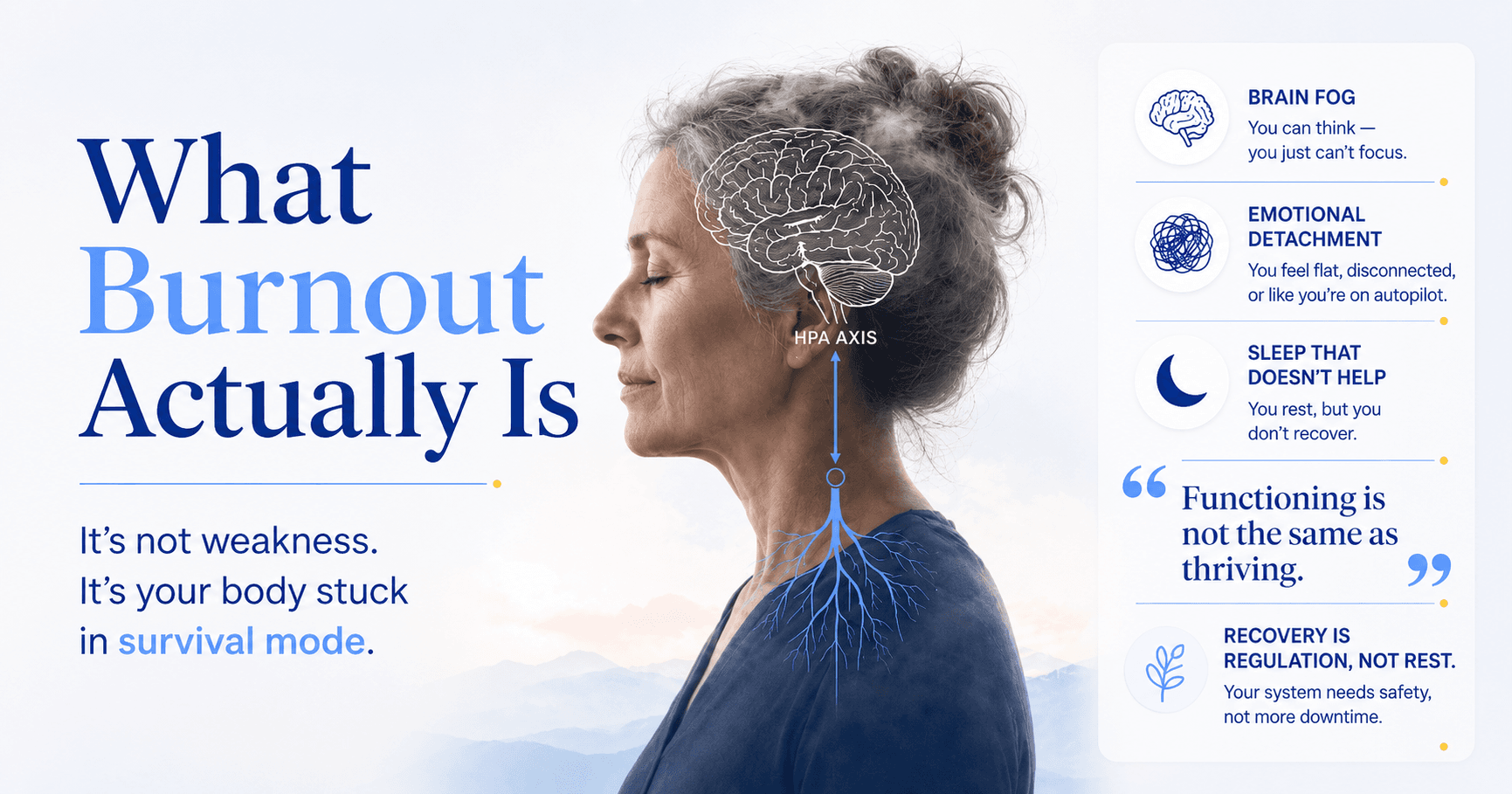
Burnout is not primarily about tiredness. It is about sustained physiological demand without adequate recovery. That is a meaningful distinction, because it changes what recovery actually requires.
What Is Happening in Your Body
When stress is chronic, the hypothalamic-pituitary-adrenal axis — the HPA axis — stays engaged. Your body keeps releasing cortisol to fuel energy and maintain performance. This works, for a while. Initially it can feel productive. Output stays high. You keep going.
But prolonged cortisol exposure is costly. It alters glucose regulation, increases insulin demand, and drives systemic inflammation. Your nervous system stays elevated. Recovery windows get shorter. Eventually the system begins to downregulate — not all at once, but gradually. Energy becomes inconsistent. Cognitive clarity slips. Recovery takes longer after smaller demands.
This is not a sudden collapse. It is a slow depletion that looks, from the outside, like function.
The Sleep That Does Not Help
One of the most disorienting parts of burnout is sleeping eight hours and waking up exhausted anyway.
That is cortisol dysregulation. Cortisol is designed to increase blood glucose to fuel the body under pressure. When stress is ongoing, the pattern becomes erratic. You may notice persistent fatigue despite adequate sleep. A second wind late at night that makes it impossible to wind down. Difficulty getting going in the morning no matter how early you went to bed. An afternoon crash that two more coffees cannot fix.
The body is exhausted and cannot fully rest. That is not a discipline problem. That is physiology.
What Happens to Your Brain
Burnout changes cognitive performance. Tasks that used to be routine start requiring more effort. Decision-making slows. Focus becomes unreliable. You walk into a room and stand there.
Chronic stress affects the prefrontal cortex, which handles executive function, planning, and decision-making. At the same time, stress increases activity in the brain's more reactive regions. The result is a shift away from strategic thinking and toward survival processing.
For women who have always been the person with the answer, this feels like losing something essential. It is not. It is a change in brain function under chronic load. Predictable. Reversible. But not reversible by pushing harder.
What the Detachment Is About
Burnout also shows up as emotional flatness. Irritability with the people you love most. Decreased interest in things that used to matter. A sense of going through the motions without being in them.
This is the nervous system conserving energy. When the body is under sustained demand, it pulls resources away from emotional processing. That detachment is not indifference. It is protection.
Understanding that does not make it feel better immediately. But it reframes the question. This is not who you are becoming. It is what happens when a system has been running hard for too long without recovery.
Functioning Is Not the Same as Thriving
This is the part that makes burnout easy to miss.
Women who carry significant responsibility are often able to continue performing even when the internal system is under serious strain. They show up. They meet expectations. They keep going. Burnout does not always look like stopping. It looks like continuing, while depleted.
That capacity to keep functioning is not a sign that nothing is wrong. It is often what allows burnout to become more severe before it gets addressed.
What Recovery Actually Requires
Recovery is not about doing less for a week. It is about restoring the body's ability to regulate.
That means creating real transitions between work and rest, not just changing locations. Supporting sleep quality, not just duration. Reducing cognitive load consistently, not just occasionally. Choosing movement that supports the nervous system rather than adds to its demand.
None of this is dramatic. That is the point. Recovery from burnout is quiet and consistent, and it does not produce immediate results. Which makes it genuinely difficult for women who are used to effort producing visible output.
This Is Information, Not Failure
Burnout is not a personal failure. It is not a lack of discipline or resilience. It is a physiological state involving the nervous system, the endocrine system, and metabolic processes that have been under sustained demand without sufficient recovery.
When you understand it that way, the question changes. It stops being "what is wrong with me" and becomes "what does my system actually need."
That second question has answers.
If you want to know where you are in the burnout cycle right now, the Integration Index is a 25-question assessment that maps your nervous system state across five domains. It takes about 10 minutes, and it gives you something specific to work with.