

Most people treat digestion and mental health as separate categories. Eat something, it gets processed, done. Anxiety lives in the mind. Gut issues live in the stomach. Different systems.
That is not how it works.
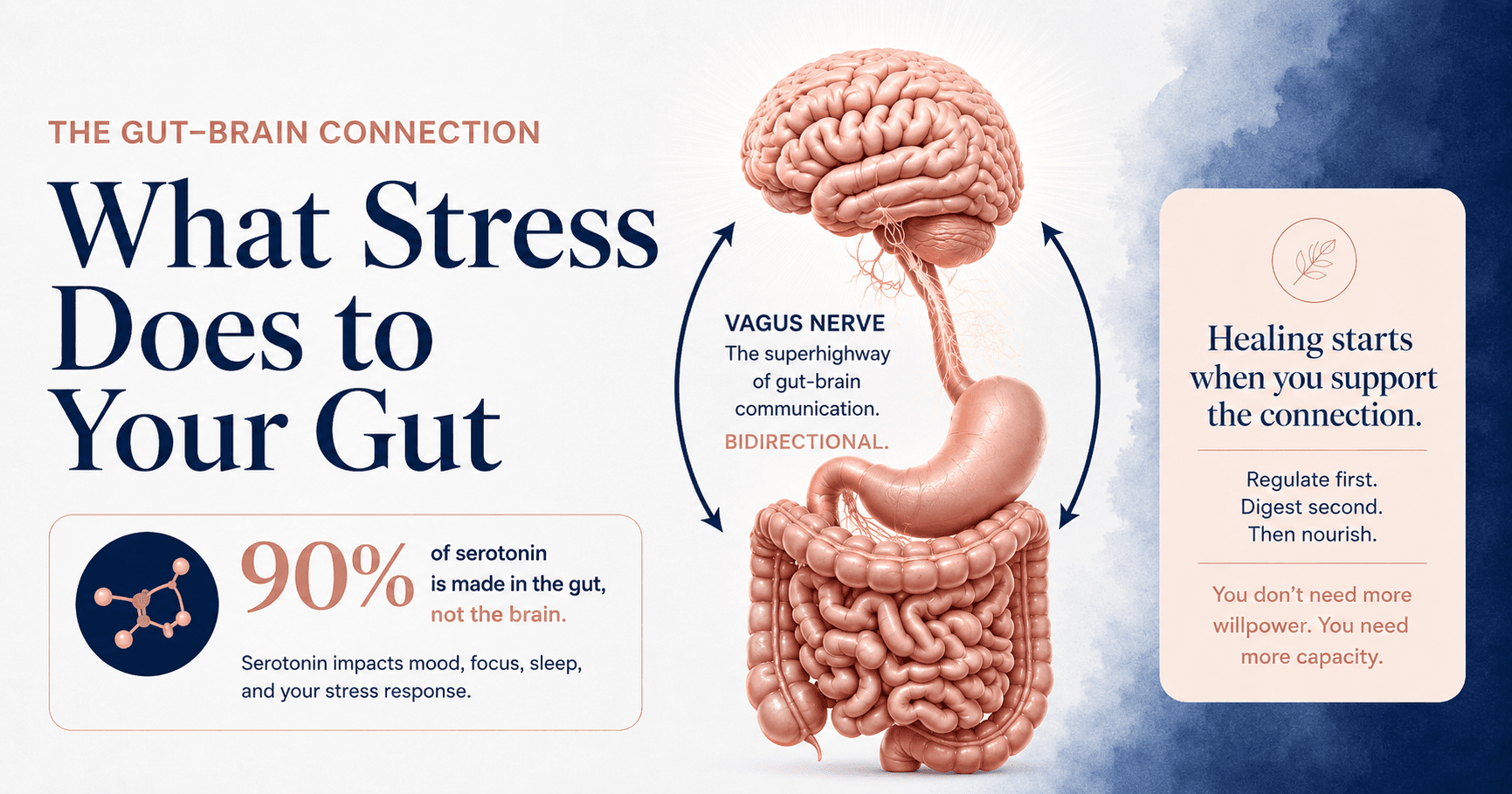
Your gut and your brain are in constant two-way communication through the vagus nerve — a direct physical link where signals travel in both directions. What happens in your gut affects your brain. What happens in your brain affects your gut. They are not running parallel tracks. They are the same system.
This matters for burnout because chronic stress does not just exhaust you mentally. It shuts down your gut.
The Serotonin Number Worth Knowing
Ninety percent of the body's serotonin is produced in the gut. Not the brain. The gut.
Serotonin is the neurotransmitter most closely associated with mood, emotional regulation, and the ability to feel settled. And most of it is made in an organ you probably associate with digestion, not mental health.
This means gut health is not a separate category from mood. It is a primary driver of it. An inflamed or dysregulated gut is not just a digestive inconvenience. It is a neurological one.
What Stress Does to Digestion
When the nervous system is under chronic stress, it prioritizes survival. Digestion is not a survival function, so the body deprioritizes it.
Specifically, stress signals the body to reduce stomach acid and digestive enzymes. Food does not break down correctly. It sits and ferments in the digestive tract. Bacterial overgrowth follows. The gut lining becomes permeable — what researchers call dysbiosis and intestinal permeability — and inflammation spreads systemically.
Here is what makes this a loop rather than a line: the nutrients your body most needs to regulate a healthy stress response are iron, B12, and magnesium. All three are absorbed in the gut. When the gut is compromised, absorption fails. The stress response becomes harder to regulate because the gut cannot deliver what the nervous system needs to regulate it.
Stress dysregulates the gut. A dysregulated gut worsens the stress response. The body stays stuck.
Why the Anxiety Might Not Be "Just Anxiety"
Anxiety can cause gut distress. The reverse is also true.
An inflamed gut can produce what researchers describe as circulating thoughts — low-grade mental noise that will not turn off, anxiety that does not have an obvious source. If you have been treating anxiety as purely a mental health problem and not finding traction, the gut is worth looking at.
This is not a claim that gut health cures anxiety. It is a claim that treating only the mind while ignoring what the gut is doing is incomplete.
What to Look For
The symptoms that come up most often: bloating that does not resolve, afternoon energy that drops off a cliff, skin issues, hair thinning, and a background hum of anxiety that does not seem tied to a specific stressor.
Most of these get attributed to stress, age, or just how things are now. They are worth paying attention to.
One practical note: if you notice blood or mucus in your stool, that is not something to wait on. It warrants a call to your doctor. An endoscopy or colonoscopy can rule out inflammation, erosion, or ulcers that a standard checkup will miss. Push for the investigation if something feels wrong.
The Coffee Problem
Most people drink coffee before eating anything. The gut does not love this.
Coffee on an empty stomach drives up cortisol and stomach acid production without any buffer. It accelerates the very dysregulation we are trying to address. The fix is simple: eat first. Something with protein. Then coffee.
Not a dramatic intervention. But a consistent one, and consistency is what the gut responds to.
Where to Start
Before any supplement does useful work, the body needs to be in a state where it can absorb it. That means nervous system regulation comes first.
Legs up the wall for 20 minutes activates the parasympathetic nervous system — the rest-and-digest state — more effectively than most things that require far more effort. Box breathing does the same. Neither takes equipment, a schedule, or a significant block of time.
Sleep is not optional here. Seven to nine hours is the window during which the gut does its repair work. Cutting that short consistently is not a trade-off. It is a ceiling on recovery.
The goal is not a perfect protocol. It is moving out of chronic survival mode long enough that the body can actually receive nourishment rather than just manage threat.
When that shift happens, the mental clarity people notice is not from a new supplement. It is from a system that finally has the resources to do its job.
If you want to see where chronic stress is affecting your nervous system right now, the Integration Index is a 25-question assessment that maps your state across five domains. It takes about 10 minutes and gives you something specific to work with.