
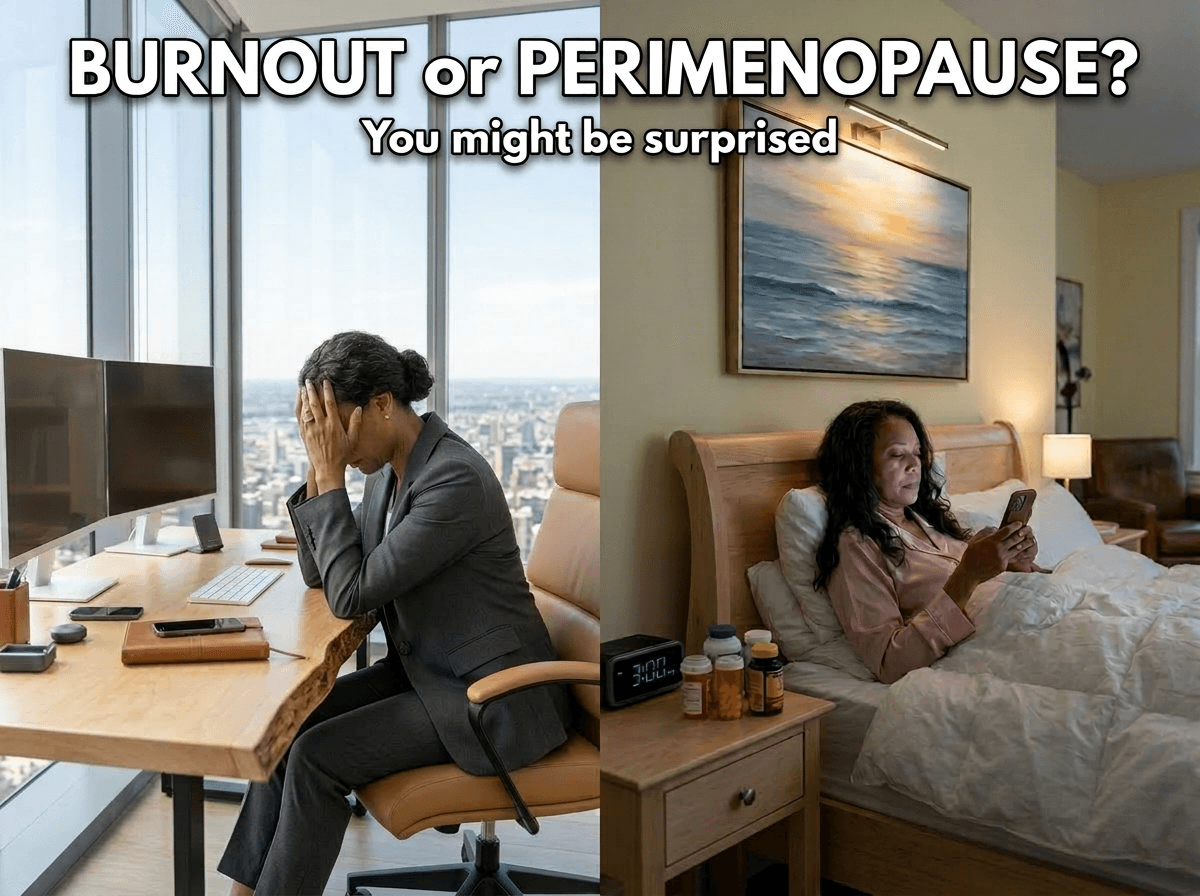

You are exhausted in a way sleep does not fix. Your mood is doing things you do not recognize. You want to leave. Not to anywhere specific. Just out.
You have been telling yourself it is stress. You have probably told your doctor the same thing.
Here is what nobody told me when I was living that exact experience: it might not only be stress. It might be your hormones. It might be burnout. It might be both of them running a tag team on your nervous system while you are just trying to get through the day.
I have 16 years of clinical experience watching burnout develop in women who carry everything and cannot figure out why nothing is working. The overlap between these two conditions is not a coincidence. It is biology.
Let's sort this out.
Why Burnout and Perimenopause Look Identical
The symptom lists are almost the same.
Sleep disruption. Mood instability. Brain fog so thick you walk into a room and stand there with no memory of why you came. Irritability that surprises even you. An exhaustion a weekend away does not touch.
If you searched your symptoms, you could land on a burnout article or a menopause forum, and both would feel like someone had been watching you from your kitchen.
That is not confusion. That is biology doing its work.
Dr. Cheryl Kingsburg, a clinical psychologist who has spent decades studying menopause, has described perimenopause as one of the most underdiagnosed conditions in midlife women. Partly because the earliest symptoms — fatigue, disrupted sleep, mood changes — look exactly like stress. Women are told to take a vacation, to meditate, to set better limits.
Sometimes that advice is right.
Sometimes, while you are downloading the meditation app, your estrogen has been quietly doing something entirely different.
What Burnout Actually Is
Burnout is not just being tired.
Herbert Freudenberger, the psychologist who first named it in 1974, described it as the result of excessive demands on energy, strength, or resources. Christina Maslach, whose research is still the clinical standard, identified three markers: emotional exhaustion, depersonalization (that flat, numb, what's-the-point feeling), and a reduced sense of personal accomplishment.
In plain language: you gave too much for too long with too little coming back, and your system shut down parts of itself just to survive.
What that looks like in real life: exhaustion that follows you into the weekend. Irritability that flares at things that never used to touch you. Cognitive fog, not because something is wrong with your brain, but because a dysregulated nervous system does not allocate resources to higher thinking. It is busy managing the threat. Which in this case is your calendar.
The wanting to run away is real. That is not a character flaw. That is your nervous system communicating that the current load is unsustainable. It is not telling you to actually leave. It is telling you something has to change.
The burnout clue that matters most: the symptoms track with the stressor. When pressure increases, you get worse. When something genuinely lightens — a real break, a slow week, actual rest — you feel slightly better. Not all the way. But there is movement. If there is movement when the stress reduces, burnout is likely in the picture.
What Perimenopause Actually Is
Perimenopause is the transition period leading up to menopause. It can start anywhere from two to ten years before your period stops. For most women, that means it can begin in the early to mid-forties. Some women start noticing it earlier.
Here is the part that catches most women off guard.
Hot flashes are not always the first symptom.
For many women, perimenopause announces itself quietly. Sleep starts getting worse. Mood feels less stable. Anxiety shows up that feels new and unanchored, like dread without a specific reason. Brain fog. Fatigue that does not respond to rest. Sound familiar?
Research published in the journal Menopause has shown that cognitive symptoms — particularly memory and concentration issues — are reported by a significant number of women during perimenopause, and that these symptoms are often attributed to stress before the hormonal connection is considered.
Dr. Lisa Mosconi at Weill Cornell has been studying what happens to the female brain during this transition. Her research shows that estrogen is not just a reproductive hormone. It is deeply involved in brain function, energy metabolism, sleep regulation, and mood stabilization. When estrogen fluctuates, the brain feels it. That is not a metaphor. That is neuroscience.
The perimenopause clues: your cycle is changing (irregular, heavier, lighter, farther apart, closer together). You are experiencing temperature regulation issues — hot flashes, night sweats, waking up overheated when the room is 68 degrees. And most importantly, symptoms persist even when life gets lighter. You take a real break, the stressor genuinely reduces, and you still feel off. Still foggy. Still emotionally unpredictable. Still exhausted.
That is your body telling you the problem is not only situational.
Why It Is Often Both
Here is what I want you to hear, because nobody said this to me clearly.
It is very often both.
Perimenopause does not pause while you are under stress. Burnout does not wait for your hormones to stabilize. They stack. They amplify each other.
Disrupted sleep from hormonal changes makes you less resilient during the day. Less resilience makes the emotional labor harder. Harder emotional labor dysregulates your nervous system further. A dysregulated nervous system makes hormone changes feel more intense.
Research from the Study of Women's Health Across the Nation — a long-term study tracking over 3,000 midlife women — found that psychosocial stress during the menopausal transition was associated with more severe symptoms. Not just more stress. More symptoms. These two conditions genuinely make each other worse.
So if you cannot tell which one this is, that is not confusion. That might be accuracy.
The question is not always either/or. Sometimes the question is: what is my body managing right now, and what does it actually need?
Five Questions to Sit With
Not a quiz. Not a 17-item checklist. Just five honest questions.
Has my cycle changed? Irregular, heavier, lighter, skipped? Any shift points toward hormones. Write it down.
Are there physical symptoms that do not track with stress? Night sweats, waking up overheated, temperature changes that feel new. These are not burnout. Talk to your doctor.
When I genuinely rest, do I feel even slightly better? If yes, burnout is likely contributing. If nothing moves even with real rest, hormones may be the bigger driver.
Did this start after a sustained period of overload? Years of too much with no recovery, constant output, no repair. That is the burnout origin story.
Am I experiencing anxiety that feels unanchored? Not anxious about something specific. Just anxious. That free-floating dread with no obvious source could be hormonal. It could also be a nervous system that has been in threat mode so long it forgot how to come off alert.
Sit with those questions. Write down what comes up. Then bring it to a doctor who will actually talk to you about hormones and not just run a panel and tell you everything is normal. Ask for a full conversation. You deserve one.
What I Know From My Own Experience
I lived the sleep disruption. I lived the mood that surprised me. I lived the wanting to be anywhere but where I was.
In retrospect, sitting here with 16 years of clinical experience and a clearer picture of my own biology, I think it was both. Burnout was real and exhausting and mine. And perimenopause was underneath it, doing its own thing, largely unannounced.
I will never know the exact ratio. Honestly, it does not matter now. What matters is that I did not know this was even a question to ask. I kept pushing. I kept assuming I was tired because I had too much to do. I kept waiting to feel better when things slowed down.
Things never slowed down. And I did not put the pieces together until much later.
You are doing that work now. That matters.
If you want a clearer picture of where your nervous system actually is, the Integration Index is a place to start. If you are ready to talk through what you are carrying, you can book a consultation.
Your body is not being dramatic. It is giving you information. Learning to read it is not optional. It is the work.